

A Compass for Learning in the Age of AI: Five Principles for Empowering Learner Agency






Shumpei Komura, President, Benesse Educational Research and Development Institute
Introduction
The rapid advancement of AI has brought education and learning to a major turning point. In particular, generative AI tools such as ChatGPT and Gemini can now perform not only increasingly sophisticated information retrieval, but also summarization, translation, question generation, and feedback provision. As a result, opportunities for both teachers and learners to use AI in their daily activities are rapidly increasing.
According to the OECD's 2024 TALIS (Teaching and Learning International Survey), the proportion of Japanese teachers using AI in classroom instruction was 20% in both elementary and lower secondary schools--significantly below the OECD average of 36% [1].
Meanwhile, a longitudinal survey conducted by the Benesse Educational Research and Development Institute and the University of Tokyo found that the proportion of students using generative AI for out-of-school learning rose sharply between 2024 and 2025: from approximately 20% to 33% among lower secondary students, and from approximately 34% to 58% among upper secondary students [2].
Against this backdrop, the question is no longer simply whether we should use AI. Rather, we must consider what AI means for education and how it should be used.
Education and AI: Where We Stand Today
What effects does AI have on education and learning? And what new challenges does it create?
Research findings from Japan and abroad suggest that generative AI can have positive effects on learning outcomes, learner motivation, and higher-order thinking [3-6].
For example, generative AI can tailor explanations to individual learners' levels of understanding and learning progress, while also providing interactive support anytime, 24 hours a day. Studies also indicate that AI can encourage trial and error and reflection by responding instantly to learners' questions and presenting diverse perspectives and examples.
These capabilities--personalization, immediate feedback, and interactive support--make it possible to provide forms of individualized assistance that were difficult to achieve in traditional education. This has accelerated interest in integrating AI into teaching and learning.
At the same time, researchers emphasize that these benefits do not emerge automatically simply by introducing AI. Their impact depends heavily on how AI is incorporated into instructional design and learning activities [7, 8]. While AI excels at adapting to individual learners and patiently repeating explanations until understanding is achieved, it is not necessarily effective at encouraging learners while reading their emotions or helping them reflect on the meaning of learning itself.
Therefore, the introduction of AI does not make teachers unnecessary. Rather, AI should be understood as something that supports teachers or partially substitutes for certain tasks. Even in the age of AI, human teachers will continue to play an indispensable role in education and learning.
The Paradox of Education and AI
How, then, can AI be meaningfully integrated into learning design and used effectively?
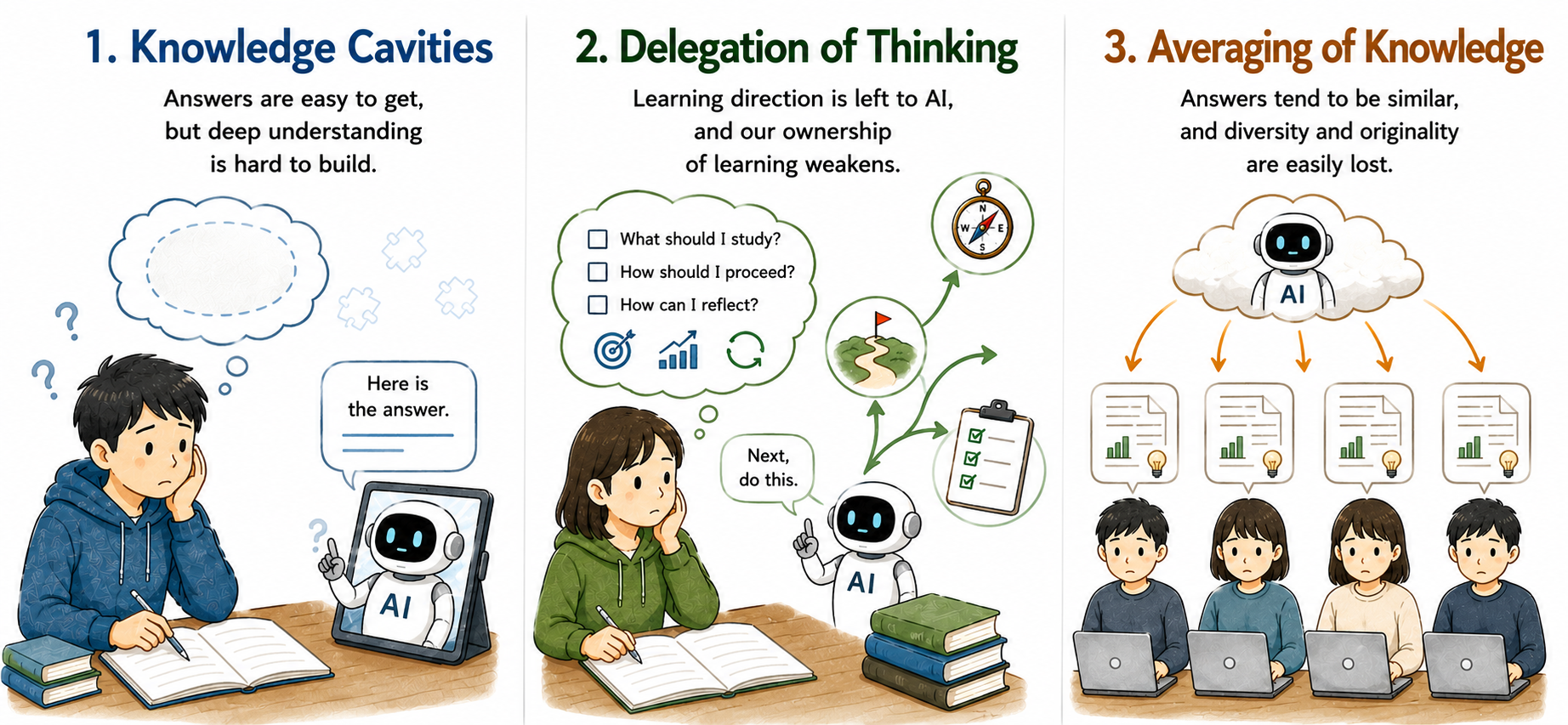
A crucial starting point is recognizing the paradox of education and AI: while AI can enhance our learning outcomes and efficiency, depending on how it is used, it may also weaken the very processes through which human understanding develops. Here, I describe this challenge from three perspectives: the hollowing out of knowledge, the externalization of agency in knowledge, and the homogenization of knowledge.
The Hollowing Out of Knowledge
Generative AI can instantly produce answers of a certain quality whenever we pose a question. Its applications range from summarizing texts and organizing arguments to writing reports, generating illustrations, and creating computer programs. In the short term, these capabilities can dramatically improve both productivity and learning outcomes.
In fact, concerns have already been raised in U.S. universities about possible grade inflation resulting from students' use of AI [9]. This has led to debates about whether educational assessment should move beyond evaluating final products alone.
What matters here is that the role of AI for working professionals is not necessarily the same as its role for learners. For professionals, AI primarily functions as a productivity tool that enables high-quality results within limited time. Efficiency and output are highly valued.
For learners, however, the learning process itself is essential. Education is not merely about producing correct answers or polished outcomes. What matters is how learners think, struggle, experiment, and deepen their understanding along the way.
The "hollowing out of knowledge" refers to the problem that arises when learners bypass the processes of trial and error through which understanding is normally constructed. Knowledge is fundamentally built by connecting new information to prior knowledge and assigning personal meaning to it. AI risks weakening this process of knowledge construction. In other words, learners may produce answers without truly internalizing understanding, creating only an illusion of comprehension.
Related to this issue is the concept of "cognitive offloading" [10], which refers to delegating some of the cognitive tasks traditionally performed by humans--such as memorization, calculation, information organization, and judgment--to tools or other people. For example, calculators reduce the burden of arithmetic, and search engines make information retrieval easier, allowing humans to focus on more advanced thinking and creative activity.
At the same time, excessive dependence on external tools can reduce opportunities for individuals to think independently, engage in trial and error, and deepen their understanding. It may also weaken the ability to examine issues from multiple perspectives and to learn autonomously.
Precisely because generative AI is such a convenient and accessible tool, there is a risk that we may become unconsciously dependent on it. It is therefore essential to consciously distinguish between what should be delegated to AI and what humans must continue to question, think through, and judge for themselves. Generative AI should not replace human thinking; rather, it should support, expand, and deepen it.
The Externalization of Agency in Knowledge
Generative AI is remarkably convenient because it can instantly provide answers and directions once a question is entered. Yet this convenience creates the risk that instead of "thinking first," people may increasingly "ask AI first."
The "externalization of agency in knowledge" refers to a gradual shift in the initiative for learning from humans to AI, reducing opportunities for learners to formulate their own questions and determine their own direction. In this state, AI--which should function as a tool supporting learning--begins to dictate the learning process itself, weakening our capacity for self-directed learning.
For working adults, this is not merely a matter of declining thinking skills. If people continually accept AI-generated suggestions uncritically, their capacity for independent judgment and accountability in professional settings may deteriorate.
For teachers, this may reduce opportunities to deeply consider questions such as: "What do we want students to learn?" and "What kinds of scaffolding are necessary to support that learning?" As a result, teachers' ability to design learning itself may weaken.
For students, this issue directly relates to what the Japanese national curriculum framework describes as "proactive, interactive, and deep learning." The curriculum emphasizes not only acquiring knowledge, but also developing the ability to formulate questions, regulate one's own learning, deepen understanding, and apply knowledge.
Learning is not always a linear journey toward a predefined goal. Rather, it deepens through questions such as "I want to know more," "Why is that?" and "Is there another perspective?" Through experiences of confusion, hesitation, and failure, learners come to understand what they do not yet know and what learning approaches suit them best. Over time, they also discover their own interests, values, and purposes for learning.
However, in environments where AI constantly anticipates learners' needs and provides answers or directions in advance, opportunities for such reflection and experimentation may diminish. Indeed, several studies [11, 12] suggest that excessive reliance on AI-generated feedback may weaken learners' metacognition--the ability to monitor and regulate one's own understanding--and may encourage more passive forms of learning.
Recent scholarship has also proposed the idea of a "third cognitive system" [13], building on Daniel Kahneman's dual-process theory. In dual-process theory, human thinking is divided into "System 1," which is fast and intuitive, and "System 2," which is slow, logical, and reflective. Some researchers now conceptualize generative AI as a third form of cognition: an externalized cognitive system.
This framework raises the possibility of "cognitive surrender," in which humans accept AI-generated judgments without sufficient critical examination simply because the answers appear plausible.
The Homogenization of Knowledge
Generative AI produces outputs based on vast amounts of data, generating expressions and structures that appear natural and reasonable to many people. As a result, its outputs often achieve a certain level of accuracy and completeness, but they also tend to become standardized and similar.
Research has shown that while AI can improve the quality and efficiency of writing, it may also weaken expressions grounded in individual experiences, values, and unique perspectives [14, 15]. This issue extends beyond personal expression. It suggests the possibility that society as a whole may become more uniform in its knowledge and values, potentially diminishing creativity and diversity.
Learning, at its core, is a process through which individuals interpret the world through their own sensibilities, create personal meaning, and develop values. Even when people encounter the same event, what they find interesting and what meaning they derive from it differ from person to person. This diversity of perspectives and values is precisely what has enabled societies and cultures to flourish.
Today, however, as AI spreads rapidly, the very conditions that nurture diverse perspectives and values are beginning to change. AI now enables anyone to quickly reach a certain level of knowledge or productivity. Yet at the same time, people may increasingly converge around similar information and modes of expression, making it more difficult to cultivate originality and creativity.
As an insight that resonates strongly with the current age of generative AI, professional shogi player Yoshiharu Habu remarked in 2006--when the internet was rapidly transforming access to knowledge:
"The greatest change brought to the world of shogi by the evolution of IT and the internet is that a superhighway for becoming stronger at shogi has suddenly been built. But at the end of that highway, there is a massive traffic jam." [16]
If everyone uses the same AI systems and encounters the same kinds of information and expression, many people may rapidly achieve a similar level of competence. Yet beyond that point, it becomes increasingly difficult to develop one's own perspective or unique forms of expression.
For this reason, in the age of AI, it is more important than ever not merely to reach answers efficiently, but to cultivate the ability to generate one's own questions and values. How education can nurture this capacity will become one of its central challenges.
Five Principles for Learning in the Age of AI
In light of these challenges, the way each of us approaches and shapes learning will become increasingly important in the age of AI. At the center of this challenge lies the concept of agency.
In OECD Education 2030 [17], the OECD developed the Learning Compass as a framework for future-oriented learning and placed learner agency at its core. Agency refers to "the capacity to set goals, reflect, and act responsibly in order to effect change." It is not merely about acquiring knowledge, but about actively directing one's own learning and actions as a participant in society.
I participated in the development of the Learning Compass from 2016 to 2021, before generative AI became widespread as it is today. Yet now, in 2026, precisely because AI can so easily provide answers and directions, I feel even more strongly that agency--the ability to think independently and shape one's own learning--is becoming increasingly important.
What, then, is essential for learners to exercise agency?
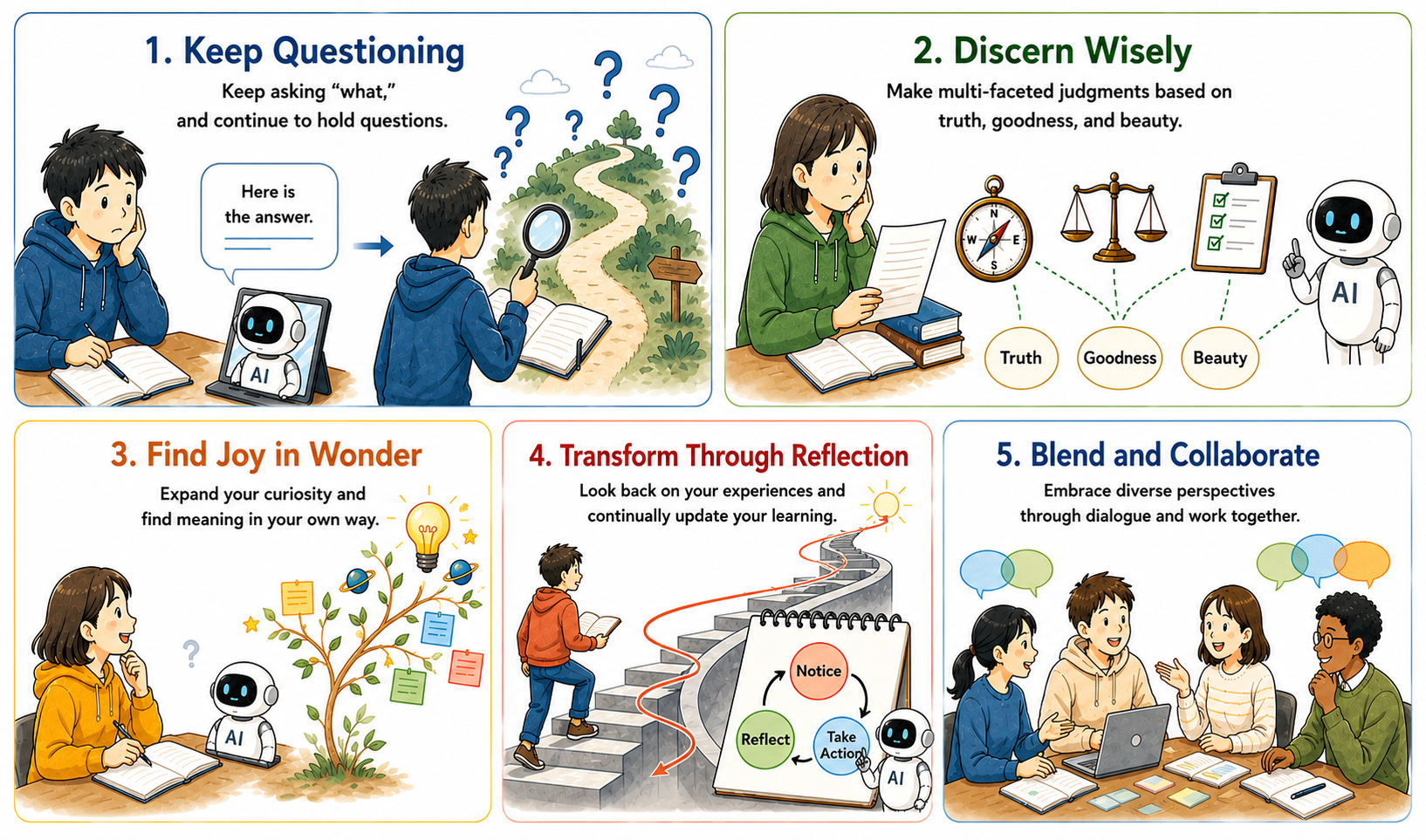
Here, I propose five principles:
1. Continue questioning
2. Discern critically
3. Cultivate curiosity
4. Reframe oneself
5. Connect and collaborate
1. Continue Questioning
To continue questioning does not simply mean mastering the technique of asking AI better prompts. AI can instantly provide answers and directions in response to human questions, but deciding what should be asked in the first place remains fundamentally a human responsibility.
Equally important is refusing to accept answers at face value. We must pause to ask: "Why is this the case?" and "Is this really appropriate?"
The key is not to focus solely on obtaining quick answers or efficient outcomes. Instead, we must resist abandoning discomfort too easily and repeatedly revisit even our own assumptions. Persisting through this process is what leads to authentic, self-directed learning.
In an age when AI can readily provide answers, learners need what might be called "intellectual stamina": the ability to resist immediate closure and continue deepening their own questions.
2. Discern Critically
Although AI is highly convenient, it can also present misinformation or biased information in highly persuasive ways. Therefore, it is essential not to accept AI-generated information uncritically, but to pause and examine whether it is truly valid and whether alternative perspectives exist.
Using AI effectively is not simply about obtaining answers efficiently; it is also about critically evaluating those answers.
Moreover, many problems in the real world do not have a single correct answer. What counts as the "best" solution depends on factors such as what priorities are chosen and for whom the outcome is desirable. Such judgments are not universally fixed; they are deeply influenced by context, timing, culture, position, and circumstance.
For this reason, humans must continue to assume responsibility for forms of judgment that AI cannot replace.
To discern critically means continually reflecting on questions such as: "What should we trust?" and "What should we value?" from multiple perspectives. Supporting such judgment are the values each individual holds and humanity's enduring engagement with questions of truth (What is true?), goodness (What is desirable?), and beauty (What has meaning and value?).
Precisely because we live in the age of AI, the ability to think critically in relation to both social values and one's own values--and to make autonomous judgments--becomes ever more important.
3. Cultivate Curiosity
AI allows us to arrive at answers efficiently. Yet learning, in its truest sense, cannot be reduced to efficiency alone.
To cultivate curiosity means nurturing the desire to know more, to ask "Why?", and to deepen learning while discovering one's own meanings and interpretations. If learning becomes focused solely on obtaining correct answers quickly, it inevitably becomes passive.
Human intellectual activity fundamentally involves drawing meaning from events and information, reinterpreting them personally, and generating new perspectives and values. Even the same event can be experienced differently depending on the individual. Continuously revising those interpretations is itself the essence of learning.
AI can provide answers and information, but determining what those answers mean and what significance we attach to them remains a uniquely human responsibility.
For this reason, in the age of AI, it becomes increasingly important to notice discoveries within everyday experiences, to approach the unknown with curiosity, and to deepen one's own questions and interpretations. Such curiosity sustains distinctly human forms of learning and becomes a driving force for shaping the future.
4. Reframe Oneself
Precisely because AI can strongly support learning, the ability to direct and regulate one's own learning becomes increasingly important.
In the age of AI, knowledge and skills become obsolete more rapidly than ever before. Prior knowledge and past success alone are insufficient. People must continue learning, adapting, and renewing themselves in response to change.
To reframe oneself does not simply mean adding new knowledge. It means updating one's understanding, values, and even ways of learning through experience, dialogue, experimentation, and reflection. At times, this requires revising one's own thinking or letting go of long-held assumptions. Learning is not only about accumulating knowledge; it is also about continuously transforming oneself.
This idea aligns with the AAR cycle proposed by OECD Education 2030--Anticipation, Action, and Reflection--which envisions learning as a spiral process of continuous renewal.
First, learners anticipate: What should I learn? Why should I learn it? How should I learn it? They establish their own goals and approaches. Next, they take action, experimenting and learning while also making use of AI. Finally, they reflect: Why did this work? What do I still not understand? What should I change next time? Through this cycle, learning evolves continuously.
At the same time, we must remain cautious. If people unconsciously continue following AI-generated answers and advice, they may lose the ability to direct their own learning. AI should not replace learning itself; rather, it should function as a tool for deepening thought.
For that reason, humans must continue asking themselves: "What do I want to learn?" and "Why do I think this way?" while actively regulating and shaping their own learning.
5. Connect and Collaborate
As dialogue with AI becomes increasingly common in everyday life, the value of dialogue and collaboration among human beings will become even greater.
To connect and collaborate does not simply mean sharing opinions or reaching agreement with others. It means engaging with people who hold different positions and values, attempting to understand one another, and collaborating respectfully--even when disagreements and tensions arise.
This practice is essential not only for addressing societal challenges, but also within schools, families, communities, and daily life.
Indeed, wellbeing research [18, 19] consistently identifies social connection as a key factor supporting happiness and life satisfaction. Feelings such as "being understood by someone" and "living together with others" cannot be obtained through convenience and efficiency alone; they are fundamental to human flourishing.
At the same time, AI increasingly provides highly personalized information and answers. Yet the more convenient this becomes, the greater the risk that individuals will remain enclosed within value systems and interests similar to their own.
For this reason, it is crucial to intentionally encounter perspectives different from one's own and broaden one's viewpoint through dialogue. Interacting with people who hold diverse values and positions may sometimes be uncomfortable or difficult, but such encounters also create opportunities to reexamine one's own assumptions and perspectives.
Friction generated through engagement with others can also become the catalyst for creating something genuinely new
Conclusion
This article has explored both the possibilities and challenges that AI brings to education and proposed five principles for enriching learning in the age of AI:
• Continue questioning
• Discern critically
• Cultivate curiosity
• Reframe oneself
• Connect and collaborate
As AI continues to permeate society, the question before us is not simply how to use AI. More fundamentally, we must ask: How should human beings learn, and how should we live?
AI makes access to knowledge easier and supports efficient, personalized learning. Yet learning, at its core, is not merely about reaching the correct answer through the shortest possible route.
Human learning resides in the process of continuing to question while grappling with uncertainty; critically discerning among multiple perspectives; approaching the unknown with curiosity and discovering personal meaning; and transforming one's own perspectives and values through dialogue and tension with others.
For this reason, rather than simply delegating learning to AI, it becomes increasingly important to cultivate agency: the capacity to formulate questions, make judgments, construct meaning, and direct one's own learning while making thoughtful use of AI.
Importantly, agency is not something teachers unilaterally "teach" or "instill" in students. Rather, it is something teachers and students continually cultivate together.
This is because the form of learning expected of students and the form of learning required of teachers are fundamentally inseparable. The relationships that shape learning--between students and teachers, children and parents, employees and supervisors--are always fractal in nature.
If students are to learn autonomously, then teachers themselves must also continue to question, learn, and renew their own practices and values.
At the Benesse Educational Research and Development Institute, we will continue exploring what competencies are essential in the age of AI, what forms of learning design can nurture them over the medium and long term, and how AI and human beings can support learning together. Through international research reviews and our own empirical projects, we hope to contribute meaningful proposals to society.
Precisely because AI is becoming increasingly sophisticated, we believe it is more important than ever to continue asking together what it truly means to "learn as human beings."
References
[1] National Institute for Educational Policy Research (NIER). (2025). OECD International Teaching and Learning Survey (TALIS) 2024: Key points from the Japan report [in Japanese].
[2] Benesse Educational Research and Development Institute and Institute of Social Science, The University of Tokyo. (2026). Japanese Longitudinal Study of Children and Parents 2025 [in Japanese].
[3] Chen, S., & Cheung, A. C. K. (2025). Effect of generative artificial intelligence on university students learning outcomes: A systematic review and meta-analysis. Educational Research Review, 49, Article 100737. https://doi.org/10.1016/j.edurev.2025.100737
[4] Xia, Q., Li, W., Yang, Y., Weng, X., & Chiu, T. K. F. (2025). A systematic review and meta-analysis of the effectiveness of Generative Artificial Intelligence (GenAI) on students' motivation and engagement. Computers and Education: Artificial Intelligence, 9, Article 100455. https://doi.org/10.1016/j.caeai.2025.100455
[5] Ba, S., Yang, L., Yan, Z., Looi, C. K., & Gašević, D. (2025). Unraveling the mechanisms and effectiveness of AI-assisted feedback in education: A systematic literature review. Computers and Education Open, 9, Article 100284. https://doi.org/10.1016/j.caeo.2025.100284
[6] Tao, S., Lan, M., Wang, M., & Li, H. (2026). Potential risks of generative artificial intelligence integration into K-12 education: A scoping review. Computers and Education: Artificial Intelligence, 10, Article 100561. https://doi.org/10.1016/j.caeai.2026.100561
[7] Wang, S., Wang, F., Zhu, Z., Wang, J., Tran, T., & Du, Z. (2024). Artificial intelligence in education: A systematic literature review. Expert Systems with Applications, 252, Article 124167. https://doi.org/10.1016/j.eswa.2024.124167
[8] Chapman, B. L., Ross, A. S., & Petraki, E. (2026). Teacher readiness for generative AI: A Theory of Planned Behaviour approach. Social Sciences & Humanities Open, 13, Article 102351. https://doi.org/10.1016/j.ssaho.2025.102351
[9] Chirikov, I. (2026). Artificial Intelligence and Grade Inflation. CSHE Higher Education Working Paper Series, 26-3. Center for Studies in Higher Education, University of California, Berkeley.
[10] Risko, E. F., & Gilbert, S. J. (2016). Cognitive offloading. Trends in Cognitive Sciences, 20(9), 676-688. https://doi.org/10.1016/j.tics.2016.07.002
[11] Yeh, S. N., & Siah, C.-J. R. (2025). Students' attitudes toward LLMs and its association with metacognitive abilities: A cross-sectional study. Nurse Education in Practice, 88, Article 104567. https://doi.org/10.1016/j.nepr.2025.104567
[12] Tu, Y.-F., Liu, G.-P., Hwang, G.-J., Chen, X.-W., & Guo, X.-G. (2026). AI self-efficacy and knowledge graph-integrated generative AI feedback in higher education. The Internet and Higher Education, 69, Article 101079. https://doi.org/10.1016/j.iheduc.2026.101079
[13] Shaw, S. D., & Nave, G. (2026). Thinking--Fast, Slow, and Artificial: How AI is Reshaping Human Reasoning and the Rise of Cognitive Surrender. Preprint. https://doi.org/10.31234/osf.io/yk25n_v1
[14] Zafar, M. B., Ali, H., & Yasin, T. (2025). Reimagining human creativity and learning in the age of generative AI: A multi-method meta-thematic synthesis. Next Research, 2(4), Article 100802. https://doi.org/10.1016/j.nexres.2025.100802
[15] Sourati, Z., S. Ziabari, A., & Dehghani, M. (2026). The homogenizing effect of large language models on human expression and thought. Trends in Cognitive Sciences. https://doi.org/10.1016/j.tics.2026.01.003
[16] Umeda, M. (2006). Web Shinkaron: Hontō no daihenka wa kore kara hajimaru [ウェブ進化論――本当の大変化はこれから始まる]. Chikuma Shobo. [in Japanese]
[17] OECD. (n.d.). The OECD Learning Compass 2030. Retrieved June 3, 2026, from https://www.oecd.org/en/data/tools/oecd-learning-compass-2030.html
[18 ] Diener, E., & Seligman, M. E. P. (2002). Very happy people. Psychological Science, 13(1), 81-84. https://doi.org/10.1111/1467-9280.00415
[19] Holt-Lunstad, J., Smith, T. B., & Layton, J. B. (2010). Social relationships and mortality risk: A meta-analytic review. PLOS Medicine, 7(7), Article e1000316. https://doi.org/10.1371/journal.pmed.1000316
About the Author
Shumpei Komura has spent nearly 20 years advancing educational innovation through research, development, and practice. His expertise includes inquiry-based learning, STEAM education, curriculum design, digital transformation in education, and the application of artificial intelligence (AI) in learning.
He has supported the transformation and establishment of more than 50 schools across Japan and has led the Benesse STEAM Festa since 2018, a nationwide community for inquiry-based learning among secondary school students. He also serves as an advisor to national and local education initiatives and contributes to international discussions on the future of education through his involvement with the OECD Education 2030 Learning Compass and other global forums.


